
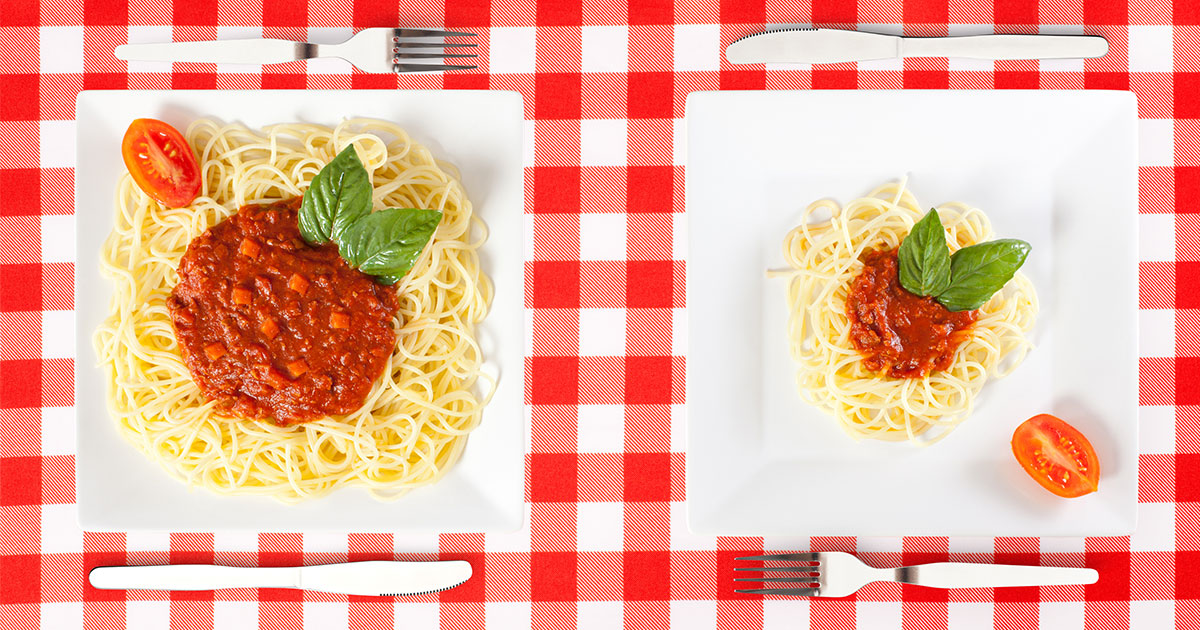
With the holiday season being right around the corner, it is more important than ever to maintain healthy eating patterns and avoid mindless eating. The holiday season makes it more difficult to control what and how much we eat. As your clinic provider, our goal is to help by educating you about Portion Control.
Portion is defined as “how much food you choose to eat at one time” and is 100% within our control.¹ A “SUPER-SIZE ME” trend has beset the food industry. Notice the increased packaging/serving sizes found in our restaurants, grocery stores, and vending machines. Food quantities that once fed two or three people are now sold as single servings. People buy into this trend unintentionally by consuming more calories from larger portion sizes, which, partly, explains the growing obesity epidemic in the U.S.²
Why Portion Control is Important!
Portion control reduces obesity. Obesity increases the risk of heart disease, stroke, diabetes, and some cancers – which are leading causes of preventable death. From 2000-2017, U.S. obesity prevalence increased from 30.5% to 41.9%.³ During that same time, severe obesity nearly doubled from 4.7% to 9.2%.³ Obesity and related diseases costed the U.S. $173 billion in 2019 dollars (latest statistics on record). Obese people pay $1,861 more in annual health care costs than those of normal weight.³
Portion Control allows us to continue enjoying the foods we like without the added worry of weight gain, associated health consequences, and added expense. The U.S. National Library of Medicine reports that portion sizes in America are 4X greater than they were in the 1950s⁴ and the Public Health and Nutrition Journal reports that 96% of restaurants exceed recommended daily allowances (RDAs) for fat, sodium, and saturated fats, some to the extent that reach near maximum levels with a single meal.⁵
When eating at home:⁴
- Avoid eating from a bag. Use recommended serving size portion on food labels.
- Buy single-size serving portions of favorite healthy snacks.
- When buying in bulk, divide into single-serving portions.
- Serve food on smaller plates, i.e, salad plates.
- Put additional servings away for left over meals.
- ½ plate = vegetables and the other ½ of plate with = parts of protein and whole grains.
- Use low-fat content to replace whole-fat dairy and use ½ your normal amount.
- Instead of whole-fat cream cheese, try using hummus or ½ sour cream with ½ plain yogurt.
- Avoid eating mindlessly; eat at the table; do not eat in front of the TV or while distracted.
- Snack on healthy, high-fiber snacks between meals, protein + carbohydrates to leave you feeling more satisfied, i.e., apples + string cheese, whole wheat crackers + peanut butter, baby carrots + hummus.
When eating out:⁴
- Order small instead of medium or large-size portions or lunch instead of dinner-size.
- Order appetizers instead of entrees, or skip the appetizer and split a large salad.
- Fill up on lower calorie foods first, eat less of the rest of your meal.
- Ask to box half of the food to take home or split the meal with someone else.
- Ask questions when eating out that may help with portion control, such as the following: a.) amount of each type of food on your plate, e.g., more rice than vegetables. b.) Size of meat on your plate c.) Amount of sauce that comes with the dish, get more vegetables than sauce. d.) Portion size of side dishes, split if too large.
Measuring portions
A portion is the amount of food that you actually eat. If you eat more or less than the recommended serving size, you may get either too much or too little of the nutrients you need.⁴
For foods like cereal and pasta, it may be helpful to use measuring cups to measure out an exact serving for a couple of days until you get more practiced at eyeballing the appropriate portion.⁴
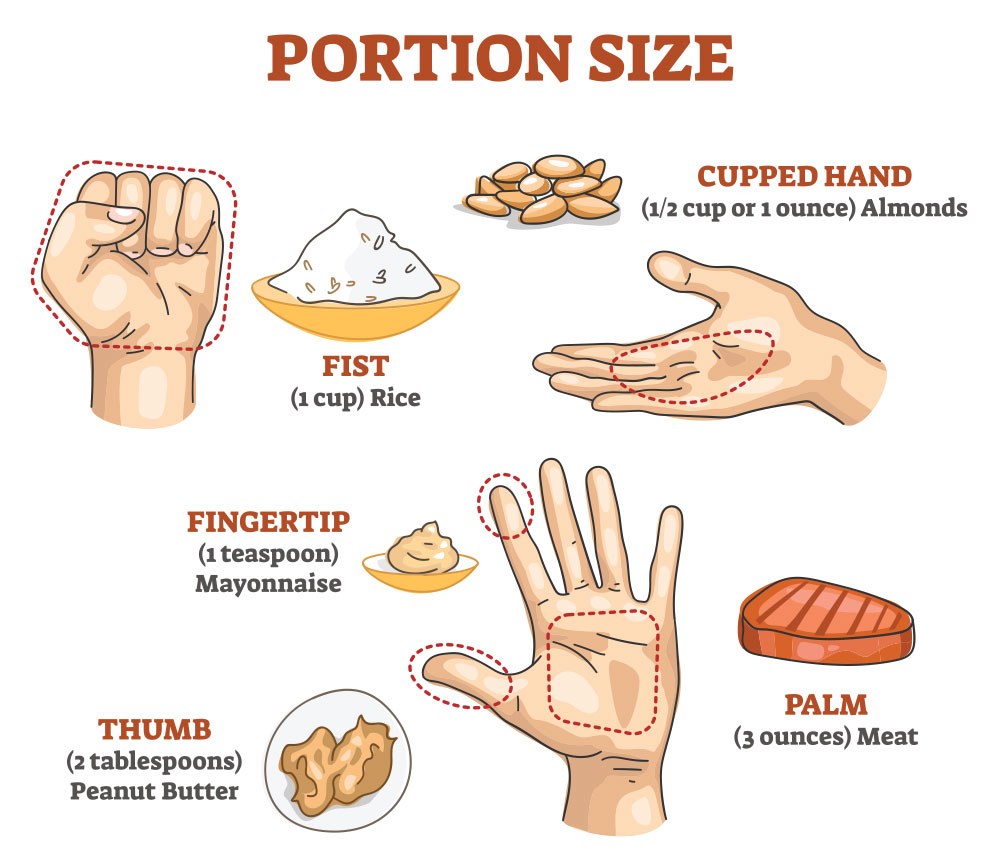
Use your hand and other everyday objects to measure portion sizes⁴:
- One serving of meat or poultry is the palm of your hand or a deck of cards
- One 3-ounce (84 grams) serving of fish is a checkbook
- One-half cup (40 grams) of ice cream is a tennis ball
- One serving of cheese is a pair of dice
- One-half cup (80 grams) of cooked rice, pasta, or snacks such as chips or pretzels is a rounded handful, or a tennis ball
- One serving of a pancake or waffle is a compact disc
- Two tablespoons (36 grams) of peanut butter is a ping-pong ball
You should eat five or more servings of fruits and vegetables each day to help reduce your risk of cancer and other diseases. Fruits and vegetables are low in fat and high in fiber.
Take the next step
Adults today consume an average of 300 more calories per day than they did in 1985. Portion sizes has grown dramatically.¹ Knowing these facts, what are you going to do to change this trend? We have given you suggestions on how to monitor how much you eat, and how to avoid eating too much. Take the next step and change your habits.
©2022HealthSpot References: 1.American Heart Association. (2016). Portion size versus serving size. Retrieved from https://www.heart.org/en/healthy-living/healthy-eating/eat-smart/nutrition-basics/portion-size-versus-serving-size 2. Centers for Disease Control and Prevention. (2016). How to avoid portion size pitfalls to help manage your weight. Healthy Weight. Retrieved from http://www.cdc.gov/healthyweight/healthy_eating/portion_size.html 3. Centers for Disease Control and Prevention. (2016). Overweight and obesity. Retrieved from http://www.cdc.gov/obesity/data/adult.html 4. U.S. National Library of Medicine. (2013). Portion size. Retrieved from https://medlineplus.gov/ency/patientinstructions/000337.htm